
Buying a property in Delhi/NCR is not just about finding the right location, negotiating the price and arranging a home loan. The real question is: Does the seller actually have a clear right to sell it?
A beautifully constructed flat in Noida, a builder floor in Delhi, a plot in Greater Noida or a property in Gurugram can look like a perfect investment—and still carry title disputes, mortgages, unauthorised construction or litigation.
Indian property law places considerable importance on due diligence by the purchaser. In fact, the Supreme Court has recently highlighted that India follows a system of presumptive title, meaning registration of a document does not by itself guarantee that the person selling the property actually has an indefeasible title. In Samiullah v. State of Bihar, 2025 INSC 1292, the Supreme Court emphasised the importance of a proper title search and examining the chain of ownership, potentially going back several decades.
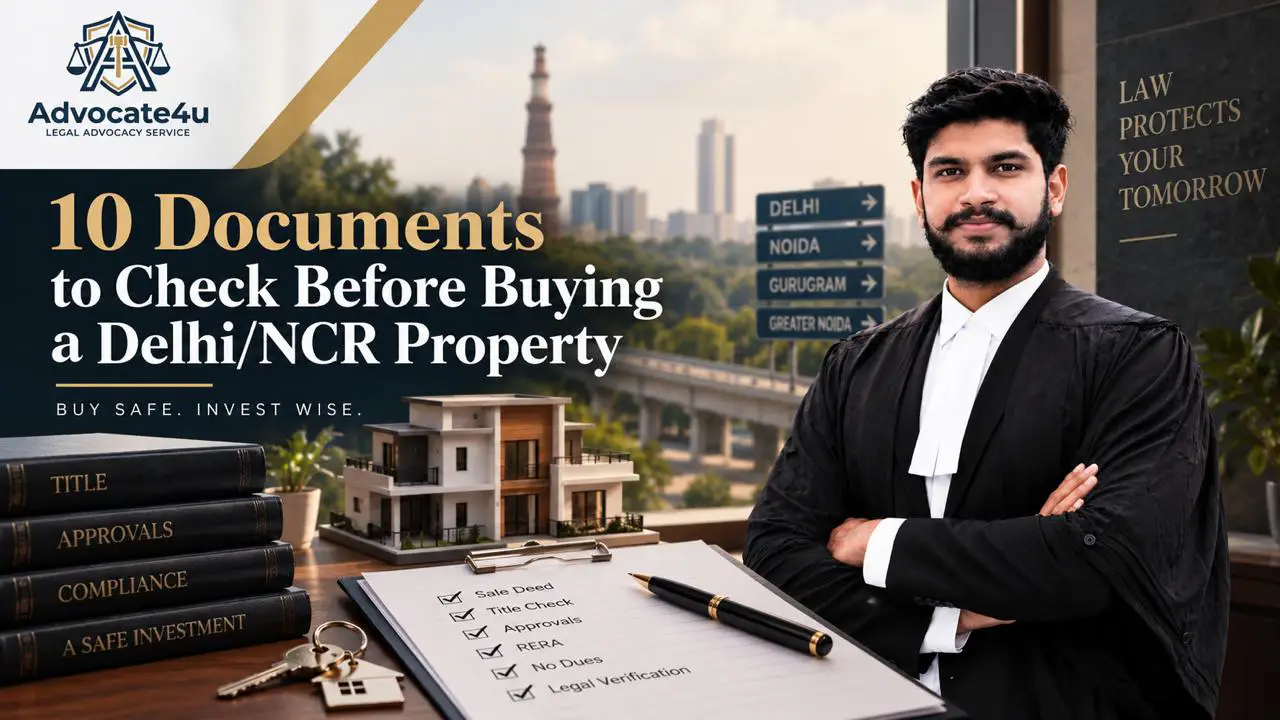
So, before paying the token money, check these 10 documents.
1. Sale Deed / Conveyance Deed
This is the most important document establishing how ownership was transferred to the present seller.
Check:
- Whether it is properly registered.
- Names of the parties.
- Property description, area and boundaries.
- Consideration mentioned.
- Registration details.
- Whether the person selling today is the same person appearing as owner in the document.
For Delhi properties, particularly older properties, you may encounter Conveyance Deeds issued by DDA, L&DO or other authorities instead of a conventional sale deed.
The Supreme Court reiterated in 2025 that an agreement to sell does not itself transfer ownership. In Ramesh Chand (D) through LRs v. Suresh Chand, the Court reaffirmed that title to immovable property cannot be transferred merely through an Agreement to Sell, GPA or similar documents; a registered conveyance is required.
2. Complete Chain of Title / Mother Deed
Don't stop at the seller's current sale deed.
Ask:
“How did this seller become the owner?”
Then ask the same question about the previous owner.
The chain may include:
Allotment → Conveyance/Sale Deed → Subsequent Sale Deed → Present Seller
For an old Delhi property, the chain may extend through several transactions, inheritance, partition, relinquishment or conversion documents.
A break in the chain can become a major problem later. The Supreme Court's 2025 Samiullah judgment specifically recognised the importance of a prospective purchaser undertaking a painstaking title search rather than assuming that registration alone establishes ownership.
3. Encumbrance Certificate / Encumbrance Search
An Encumbrance Certificate (EC) or appropriate registration-office search can help identify registered transactions and encumbrances affecting the property, such as mortgages or certain charges.
But don't make the mistake of treating a “clean EC” as an absolute guarantee.
A proper lawyer should also examine:
- Registered mortgages
- Attachments
- Previous sale agreements
- Court orders
- Charges
- Other records relevant to the property
This is particularly important because a property can have complications that are not apparent from one certificate alone.
A Delhi High Court proceeding in Vinod Kumar Rana v. Edelweiss Assets Reconstruction Co. Ltd. (2025) illustrates why charge verification matters. The Court examined the significance of CERSAI records in relation to a mortgage claim and observed that the purchaser's due diligence and the timing of registration of the charge were material considerations.
4. Mutation / Revenue Records
Mutation records show that the property has been entered in the name of a person for revenue or municipal purposes.
But remember:
Mutation is not the same as ownership.
The Supreme Court has repeatedly held that mutation does not create or extinguish title. More recently, in Samiullah, the Court again explained the distinction between registration, mutation and ownership.
Therefore, check the mutation record—but never rely on mutation alone.
This is particularly relevant for inherited properties, agricultural land and properties around the NCR where revenue records can be important.
5. Approved Building Plan
Buying the property is one thing. Buying a legally constructed property is another.
Check the sanctioned building plan issued by the relevant authority—such as MCD, DDA, GNIDA, Noida Authority, GMDA or another competent authority, depending on the location.
Compare the approved plan with the actual property.
Look for:
- Unauthorised additional floors
- Basement misuse
- Excess construction
- Setback violations
- Unapproved structural alterations
- A property may have a valid title but still contain unauthorised construction.
6. Completion Certificate (CC)
The Completion Certificate generally confirms that construction has been completed in accordance with applicable approvals and requirements.
For a newly constructed property, verify whether the project has received the required completion documentation from the competent authority.
Don't assume that possession of the flat automatically means the entire project is legally complete.
7. Occupancy Certificate (OC)
The Occupancy Certificate is particularly important for apartments and completed buildings.
It indicates that the competent authority has certified the building for occupation, subject to the applicable regulations.
Before taking possession, verify:
Is the OC actually issued for the building/phase and does it cover the unit in question?
An apartment being physically ready does not necessarily mean that all statutory approvals have been obtained.
8. RERA Registration and Project Documents
If the project falls within the scope of the Real Estate (Regulation and Development) Act, 2016, verify its registration with the applicable State/UT RERA authority.
RERA gives an allottee rights to obtain information concerning sanctioned plans, layout plans, specifications and other project information. It also requires a promoter to execute a registered conveyance deed and transfer title in accordance with Section 17.
For a builder project, check:
- RERA registration
- Sanctioned plans
- Promoter details
- Project completion date
- Litigation disclosures
- Encumbrances disclosed on the RERA portal
- Agreement for Sale
Important: RERA registration is not a substitute for independent title verification.
9. Property Tax Receipts and No-Dues Documents
Ask for the latest property-tax receipts and applicable no-dues certificates.
Also verify, where relevant:
- Electricity dues
- Water dues
- Maintenance charges
- Society/RWA dues
- Ground rent
- Authority dues
A buyer should not casually assume that every outstanding liability disappears when the property changes hands.
For builder projects, also check whether the promoter has outstanding obligations to the authority or association.
10. Litigation, Mortgage and Authority Search
This is the document check that many buyers completely skip.
Before purchasing, conduct searches for:
- Pending court cases
- Property attachments
- Bank mortgages
- Acquisition proceedings
- Land-use restrictions
- Government claims
- Insolvency proceedings, where relevant
- Disputes involving the seller or title
In K. Gopi v. The Sub-Registrar, 2025 INSC 462, the Supreme Court made an important point: the registering authority is generally not the adjudicator of the seller's title. Even registration of a document does not mean the State has guaranteed that the seller possessed valid title.
That is precisely why the buyer must conduct independent due diligence before the transaction.
One More Delhi/NCR Warning: Don't Rely on GPA Property
Delhi has a long history of transactions involving Agreement to Sell + GPA + Will + Possession Letter arrangements.
But these documents should not be casually treated as equivalent to a registered sale deed.
The Supreme Court's 2025 decision in Ramesh Chand v. Suresh Chand once again reinforced that an Agreement to Sell or GPA does not itself convey ownership.
Similarly, in Sanjay Sharma v. Kotak Mahindra Bank Ltd., the Supreme Court dealt with an attempted ownership claim based on unregistered documents and reiterated the importance of a registered instrument for transfer of immovable property.
The Bottom Line
Before buying a Delhi/NCR property, don't ask only:
“Is the property good?”
Ask:
“Is the title good?”
A safe property purchase should ideally involve verification of the title chain, registered conveyance, encumbrances, mutation/revenue records, sanctioned plans, CC, OC, RERA records, tax/dues and litigation/charge records.
And remember one crucial lesson from the Supreme Court's recent property jurisprudence:
Registration of a document is not the same as a government guarantee of title.
Spending a little more time and money on independent legal due diligence before paying the token amount can save a buyer from years of litigation and potentially enormous financial loss.
Because in property law, the most expensive mistake is often the one made before signing the sale deed.
Disclaimer: This article is for general legal awareness and does not constitute legal advice. Property documentation and approval requirements can vary depending on whether the property is in Delhi, Noida, Greater Noida, Ghaziabad, Gurugram, Faridabad or another NCR jurisdiction. A property lawyer should independently verify the documents and title before any substantial payment or execution of the transaction.