
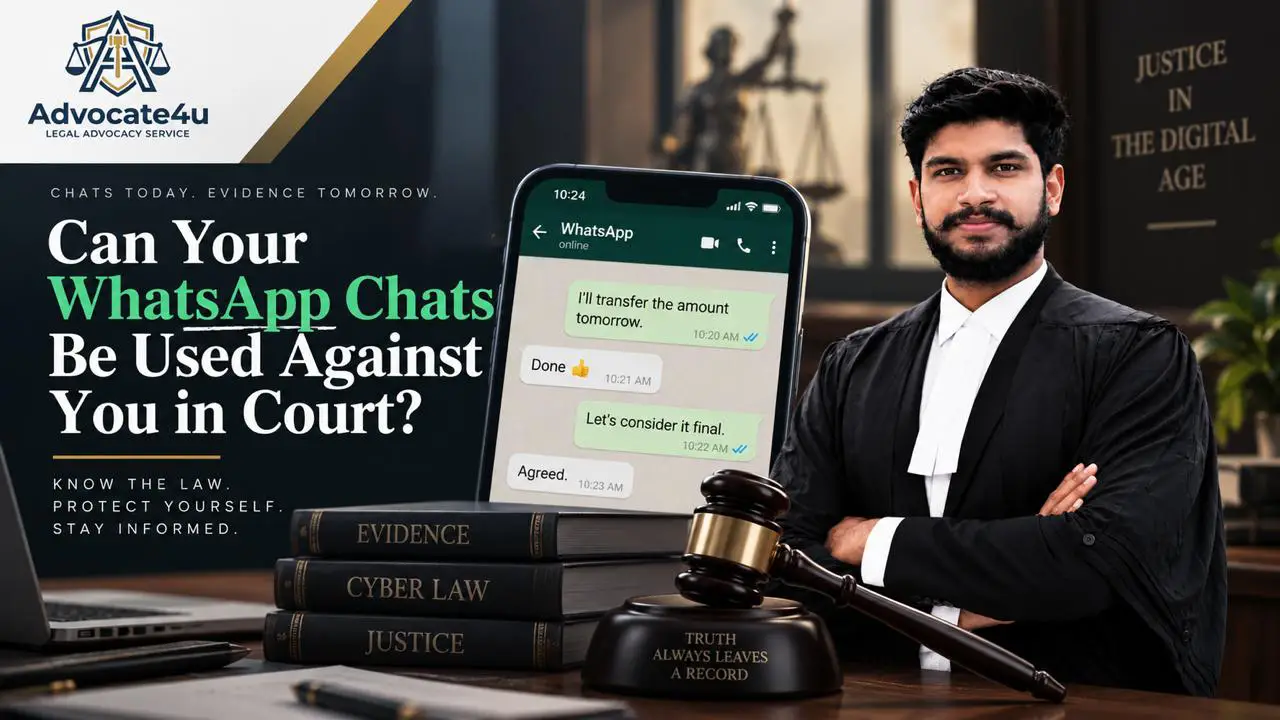
That WhatsApp message you sent as a joke, the payment confirmation you received, or even a seemingly harmless “I agree” could one day become evidence in a courtroom. But can a simple screenshot really be used against you?
The answer is yes—but with an important qualification.
Indian law recognises electronic records as evidence. Since 1 July 2024, electronic evidence is primarily governed by the Bharatiya Sakshya Adhiniyam, 2023 (BSA), which replaced the Indian Evidence Act, 1872. The BSA expressly recognises electronic and digital records, including messages stored on smartphones and other devices, as documents.
So, your WhatsApp chat is not automatically “just a conversation.” Depending on the dispute, it can become a piece of evidence.
Your WhatsApp chat can become evidence
Imagine this.
You message someone:
“I will pay you ₹2 lakh next week.”
Months later, a dispute arises over whether you actually owed that money.
The other person produces the WhatsApp conversation before a court.
Can the court consider it?
Potentially, yes.
WhatsApp messages can be relevant in disputes involving money, contracts, employment, matrimonial matters, property, criminal allegations and many other situations.
But there is a major difference between having a screenshot and successfully proving the contents of that screenshot in court.
That is where the rules relating to electronic evidence become important.
What does Indian law say?
The Bharatiya Sakshya Adhiniyam, 2023 is now the principal legislation governing evidence.
Section 61 — Electronic or digital records
Section 61 provides that an electronic or digital record cannot be rejected merely because it is electronic. Subject to the requirements of Section 63, it has the same legal effect, validity and enforceability as other documents.
In simple terms:
Digital does not mean legally inferior.
A WhatsApp message can have evidentiary value just like a traditional document—but the law also wants safeguards to establish its authenticity.
Section 63: The important rule for WhatsApp screenshots
Section 63 of the BSA deals with the admissibility of electronic records.
Where electronic information is produced as computer output—for example, a printout, copied file or other electronic reproduction—the provision lays down conditions concerning the device, manner of production and reliability of the record.
Section 63(4) also requires a certificate accompanying the electronic record when it is sought to be admitted under that provision. The certificate identifies the electronic record, explains how it was produced, gives details of the relevant device and addresses the conditions relating to proper functioning and accuracy.
This is the modern equivalent of the familiar Section 65B certificate under the old Indian Evidence Act.
What if I only have a screenshot?
This is where people often misunderstand the law.
A screenshot is not automatically useless, but neither is it automatically conclusive proof.
The court may need to determine:
- Who actually sent the message?
- Whose phone contained it?
- Has the screenshot been altered?
- Is the conversation complete or selective?
- When was it created?
- What device produced the copy?
- Can the electronic record be properly authenticated?
- Does the evidence satisfy the applicable requirements of the BSA?
In other words:
A screenshot may show what a conversation appears to say. It still has to be properly proved when its admissibility or authenticity is disputed.
The Supreme Court's landmark rulings
The rules did not suddenly appear with the BSA. The Supreme Court has spent years developing the law governing electronic evidence.
1. Anvar P.V. v. P.K. Basheer — 2014
This is one of the foundational judgments on electronic evidence.
The Supreme Court held that secondary electronic evidence had to comply with Section 65B of the Indian Evidence Act. The Court treated Section 65B as the special statutory framework governing admissibility of such electronic records.
Although the Indian Evidence Act has now been replaced by the BSA, the principles developed in these judgments remain highly relevant when understanding the evolution of Indian electronic-evidence law.
2. Arjun Panditrao Khotkar v. Kailash Kushanrao Gorantyal — 2020
The Supreme Court's three-judge Bench clarified the position further.
The Court reaffirmed that the certificate contemplated by Section 65B(4) was mandatory for secondary electronic evidence, while also recognising an important distinction where the original electronic device itself is produced as evidence.
The judgment also explained that where the person seeking to rely on electronic evidence cannot obtain the certificate because the relevant device is in someone else's control, the court has mechanisms to require production of the necessary certificate.
This principle is particularly important for WhatsApp evidence because the original phone may be with the opposing party.
A recent Delhi development: WhatsApp can actually modify a contract
The law has moved beyond merely asking whether WhatsApp chats are “admissible.”
A fascinating recent example comes from Delhi.
In Harjinder Kumar Khatter & Anr. v. Deepika Ralhan, decided by the District Judge (Commercial Court), Delhi, on 23 March 2026, the court considered WhatsApp communications concerning modification of rent terms.
The court held that properly proved WhatsApp communications could establish an agreement between the parties and relied upon the developing legal recognition of digital communications. It referred to Section 90 and Section 63 of the BSA and earlier Supreme Court and Delhi High Court authorities concerning WhatsApp evidence.
The significance is huge for everyday transactions:
Your WhatsApp conversation can potentially do more than prove what someone said—it may help establish what the parties actually agreed to.
However, whether a WhatsApp exchange creates or modifies a legally enforceable contract will still depend on the facts and the requirements of contract law.
What about a WhatsApp chat on your own phone?
A significant recent development came from the Andhra Pradesh High Court in 2026.
In Sri Mangena Sri Venkataramana v. Smt. Mangena Sri Anusha Devi, the High Court considered WhatsApp screenshots and other electronic material produced from a party's own device.
The Court held that a self-certificate by the person having lawful control of the device can be legally sufficient for WhatsApp messages or recordings from that device, provided the statutory requirements are satisfied. The certificate must identify the electronic record, explain how it was produced, provide relevant device details and address proper functioning.
This is an important practical development under the BSA regime.
Can someone simply edit a WhatsApp chat and use it against you?
Not legitimately.
This is precisely why courts are concerned with authenticity.
Electronic records can potentially be manipulated, selectively copied or altered. The Supreme Court in Arjun Panditraostressed the importance of safeguards relating to the source and authenticity of electronic evidence.
If someone produces only a few screenshots, you can potentially challenge:
- authenticity;
- completeness of the conversation;
- identity of the sender;
- integrity of the device;
- possibility of alteration;
- context in which the message was sent.
The court ultimately decides what weight should be given to the evidence after considering admissibility, authenticity and the surrounding circumstances.
Does WhatsApp's end-to-end encryption protect your messages from court?
No—not in the sense of making them legally unusable.
End-to-end encryption is a technological security feature. It does not create a blanket rule that WhatsApp conversations can never be presented as evidence.
If a participant already possesses the conversation on their device, that electronic record may potentially be produced before a court, subject to the applicable evidentiary requirements.
The real legal question is not:
“Was this sent on WhatsApp?”
It is:
“Can this electronic record be properly proved, authenticated and shown to be relevant to the case?”
Think twice before sending that message
For today's generation, WhatsApp has effectively become an informal record-keeping system.
People use it to:
- negotiate prices;
- confirm payments;
- accept jobs;
- discuss salaries;
- agree to business terms;
- make promises;
- discuss property transactions;
- communicate with employees;
- exchange confidential information.
That casual “Done ” may feel insignificant today.
But tomorrow, someone could argue that it proves acceptance.
Likewise, a message saying “I owe you the money” could become relevant in a financial dispute.
Context matters—but so does the digital trail.
What should you do if your WhatsApp chat may become evidence?
Don't delete or alter it.
Preserve the conversation in its original form and retain the device containing the relevant data wherever possible.
If the matter is likely to become litigation, avoid relying solely on cropped screenshots. Preserve the complete conversation, relevant media, dates and surrounding communications.
And if you receive a legal notice or are already involved in litigation, consult a lawyer about the correct manner of producing and authenticating the electronic record under the Bharatiya Sakshya Adhiniyam, 2023.
The Bottom Line
Yes, your WhatsApp chats can be used as evidence in an Indian court.
But a screenshot is not automatically a guaranteed win.
Indian law requires electronic evidence to satisfy applicable requirements concerning admissibility, authenticity and proof. The BSA has now replaced the old Section 65B framework with Section 63, while landmark Supreme Court decisions such as Anvar P.V. and Arjun Panditrao Khotkar continue to provide the foundation for understanding electronic evidence.
And recent decisions show just how significant WhatsApp evidence has become—from proving conversations to potentially establishing contractual arrangements.
So before you type “I agree”, “I'll pay you”, or “Consider it confirmed”, remember:
On WhatsApp, your words may disappear from the screen—but they don't necessarily disappear from the law.
Disclaimer: This article is intended for general legal awareness and does not constitute legal advice. The admissibility and evidentiary value of a particular WhatsApp conversation depend on the facts of the case, the manner in which the electronic record is produced, applicable procedural requirements and the court's assessment.